PMG's highly skilled mercury assessment teams are equipped with patented sampling and analysis technologies to execute detailed programs. Our approach ensures high-quality, representative data to support mitigation and compliance efforts across Health and Safety, Environmental Compliance, and Process Equipment needs. With a focus on reliability and accuracy, our services provide essential insights to inform safety and operational strategies.

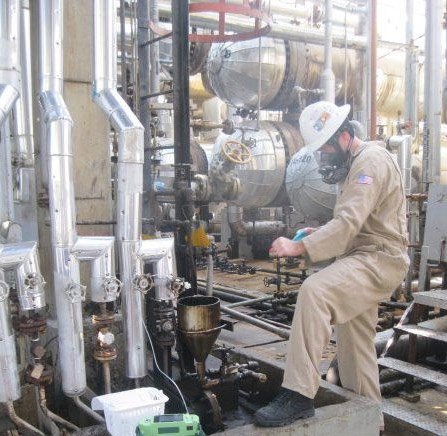
The Process Mercury Group (PMG) provides specialized consulting and technology for the management and mitigation of mercury encountered during the production and processing of oil and gas. Our skilled team is constantly working on delivering innovative methods, technologies, and solutions for the assessment and mitigation of mercury and toxic metals. Mercury present in oil and gas process streams accumulates in process equipment, poisons precious metal catalysts and under certain conditions can cause the loss of pressure containment in brazed aluminum heat exchangers. The resolution to these problems requires an accurate assessment of process conditions and equipment.
Our approach to the accurate characterization and quantitation of (total gaseous) mercury in natural gas is based on the use of sorbent trap sampling techniques employing sampling and analysis equipment specifically designed for the natural gas industry. Our techniques are based on internationally accepted methods, many of which we have modified to improve the accuracy, precision, and representativeness of results. The methods are consistent with the following:
Whether our clients require accurate measurement of mercury concentrations down to & below 10 ng/Scm or closer to 100 ng/m3 (ALPEMA’s recommended limit for brazed plate and fin aluminum heat exchangers), we deliver a rigorous, performance-based QA/QC protocol that consistently ensures data with very high confidence in accuracy, precision and representativeness.
The PMG team has a long history of developing methods and equipment for the sampling and analysis of mercury in oil and gas. The founders of PMG first designed and deployed mercury sampling systems in 2005. In September of 2014, the founders of PMG developed a new approach and a significant design improvement (Mercury-In-Gas, MIG) for sampling mercury in natural gas. The MIG relies on critical orifice technology to reduce process pressure of the gas to a safe and manageable pressure for sampling. The critical orifice replaces the traditional diaphragm regulator as the pressure reduction method. This advanced sampling system design, allows for a simplified sample stream flow path, drastically reducing the potential for sample contamination – a significant problem with mercury sampling which is most often the cause of poor data quality and inaccurate mercury measurements.